Hold Cleanliness Survey in Brazil | Cargo Readiness Checks

Cargo Hold Cleanliness Condition Survey in Brazil: Readiness Checks Before Grain Loading
What is a Cargo Hold Cleanliness Condition Survey?
A Cargo Hold Cleanliness Condition Survey (also referred to as a Hold Cleanliness Inspection or Hold Readiness Survey) is an evidence-based inspection performed on bulk carriers at Brazilian ports and anchorages to confirm whether cargo holds are in an acceptable condition to load the next intended cargo—commonly soybeans, corn, sugar, and other contamination-sensitive commodities.
This service is part of CARGOWARD’s survey and inspection division. Its purpose is loss prevention: reducing the likelihood of cross-contamination, cargo rejection, delay, and subsequent claims by documenting hold condition against the agreed acceptance standard.
Key point: this is not a cleaning service. It is a technical readiness verification with an audit-ready evidence pack.
When is a hold cleanliness survey typically required?
This survey is usually requested when:
The vessel is changing from a higher-risk cargo (e.g., petcoke/coal/mineral residues) to a sensitive cargo (e.g., sugar/grain).
Charterers, receivers, or P&I stakeholders require confirmation that holds are acceptable before allowing loading.
The vessel’s schedule is tight and the operator needs early visibility to avoid last-minute rework at berth.
There is concern about residual cargo, odour, moisture, rust scale, or loose coating—frequent causes of rejection.
Why “acceptable” must be defined before inspection
Acceptance depends on:
Next cargo and declared sensitivity.
Contractual wording / stakeholder expectations (e.g., “grain clean”, “sugar standard”, “hospital clean”).
Operational context (berth vs anchorage, lighting, access, drying time).
CARGOWARD runs this inspection under scope-confirmed acceptance logic:
Next cargo and target cleanliness standard.
Cargo history and cleaning history (what was discharged and what preparation has been completed).
Time available for drying/ventilation.
Any prior rejections or known problematic holds.
This avoids ambiguity and makes the result “usable” for operations and stakeholders.
Practical scenario: petcoke to sugar (survey role vs cleaning role)
If a bulk carrier discharges petcoke at Port of Pecém and plans to load sugar at Port of Santos, the vessel will typically need holds prepared to a high cleanliness standard.
Cleaning execution may be required depending on current condition.
The survey then verifies and documents readiness: the inspection result is what supports the “go/no-go” decision before loading.
In other words: cleaning may prepare the holds, but the condition survey determines whether they are acceptable for the next cargo, at that time, under that scope.
How CARGOWARD surveyors execute the inspection in Brazil (method and checkpoints)
1) Pre-boarding scope confirmation
Before boarding, the surveyor confirms:
Vessel particulars and hold configuration.
Intended cargo + acceptance standard requested by client/stakeholders.
Location constraints (port/anchorage), timing, lighting, terminal restrictions.
Safety requirements and access conditions.
2) Safety and entry controls
Hold entry is only conducted when access and working conditions are acceptable, including:
Safe access routes (ladders/platforms).
Ventilation readiness where applicable.
Risk controls for elevated areas and confined spaces (as required).
3) Structured inspection of cargo hold structures
Surveyors follow a repeatable route to cover contamination-risk areas:
Access & interface
Coamings, access ladders, landing platforms, and “first impression” surfaces.
Primary hold structures
Bulkheads / corrugations
Frames / stiffeners
Upper ledges and brackets (common residue traps)
Tank top (critical for dust, wetness, residues)
Bilge wells / suctions / low points
Corners, recesses, and drainage paths.
Condition risk checks
Visible traces of previous cargo.
Dust and particulate residues in high/hidden areas.
Rust scale / rust flakes (contamination and rejection risk).
Loose coating/paint, blistering, delamination.
Standing water / wet patches and blocked drainage.
4) Practical verification techniques
Depending on scope and cargo sensitivity, the survey may include:
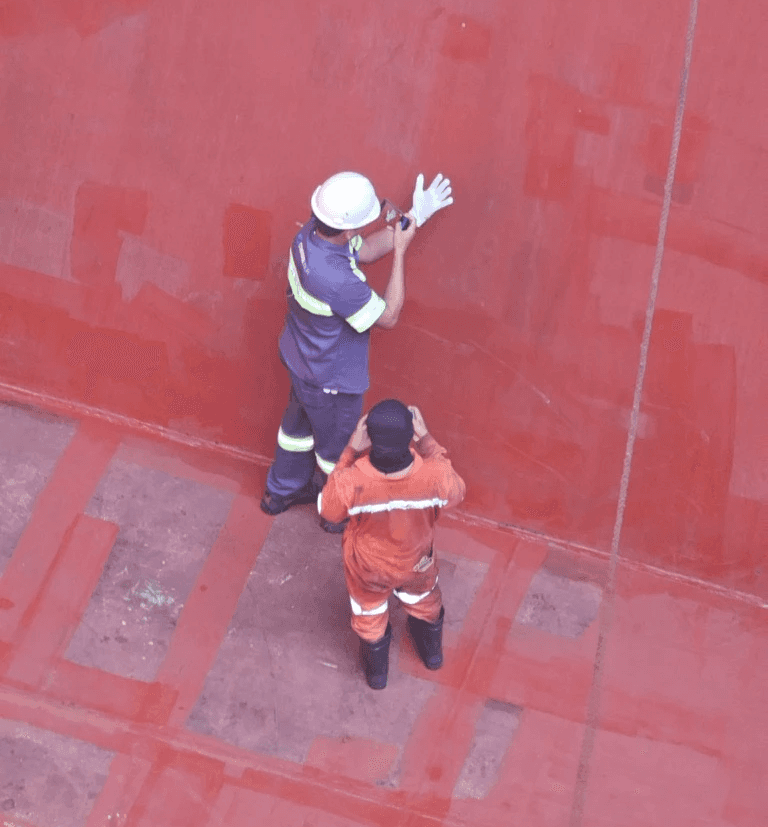
White glove checks on representative surfaces (ledges, frames, ladders, tank top edges) to confirm fine residue transfer.
Odour checks when cargo is odour-sensitive.
Ventilation status and dryness indicators relevant to acceptance expectations.
5) Evidence pack and reporting (audit-ready)
Deliverables typically include:
Photos/videos per hold and per checkpoint area.
Findings written in operational language (what, where, why it matters).
A hold-by-hold acceptance statement when required by scope.
This evidence pack is designed to support coordination between owners, charterers, agents, terminals, and P&I stakeholders.
Most common reasons holds fail (and what the survey flags early)
A hold may be rejected due to:
Residual dust (especially on upper structures and ledges).
Rust scale/flakes that can fall onto cargo.
Wetness/standing water incompatible with cargo requirements.
Odour incompatibility.
Incomplete cleaning of bilges/low points/corners.
A key advantage of a structured survey is identifying issues before loading time pressure creates delays and disputes.
Coverage in Brazil
CARGOWARD performs surveys at major Brazilian ports and anchorages, including Santos, Paranaguá, Rio Grande, Vitória, Pecém, Itaqui, Suape, Salvador, Recife, and others subject to access and scheduling.
For the up-to-date list, use the Coverage section on the Contact page.
Request a Hold Cleanliness Condition Survey
To request this inspection, share:
Vessel name and ETA/ETB
Port/anchorage
Intended cargo and target standard
Previous cargo and cleaning preparation status
Constraints (terminal rules, access, timing)
CARGOWARD will confirm feasibility, safety conditions for entry, and survey execution logistics.
FAQ
What is a cargo hold cleanliness condition survey?
An evidence-based inspection that verifies whether bulk carrier holds are acceptable for the next cargo under the agreed standard, with photo/video documentation.
Is this inspection the same as cargo hold cleaning?
No. Cleaning is the execution work. The survey is the independent verification that holds are acceptable for loading at that time, under the confirmed scope.
Who typically requests a hold cleanliness inspection?
Owners/operators, charterers, receivers, agents, and stakeholders involved in cargo acceptance and loss prevention, especially for grain and contamination-sensitive cargoes.
What do surveyors check inside the holds?
Access areas, bulkheads/corrugations, frames/stiffeners, ledges, tank top, bilge wells/low points, corners, and any surfaces likely to retain residue, moisture, or rust scale.
What is the white glove test used for?
To detect fine dust/residue transfer that can contaminate sensitive cargoes even when the hold looks visually clean.
What are the most common rejection causes?
Residual dust, rust scale/flakes, wetness/standing water, odour incompatibility, and incomplete cleaning of upper structures, corners, and bilge wells.
Does a “pass” guarantee terminal or charterer acceptance?
It supports readiness decisions with evidence, but final acceptance depends on the agreed standard, stakeholder expectations, and the condition at loading.
How can operators reduce the risk of rework and delay?
Confirm the target standard early, prepare holds accordingly, allow drying/ventilation time, and schedule the survey once readiness is realistic.
If preparation work is needed before the survey, can CARGOWARD support it?
CARGOWARD can coordinate the readiness workflow. If cleaning execution is required, it should be scoped separately and aligned to the agreed acceptance standard.