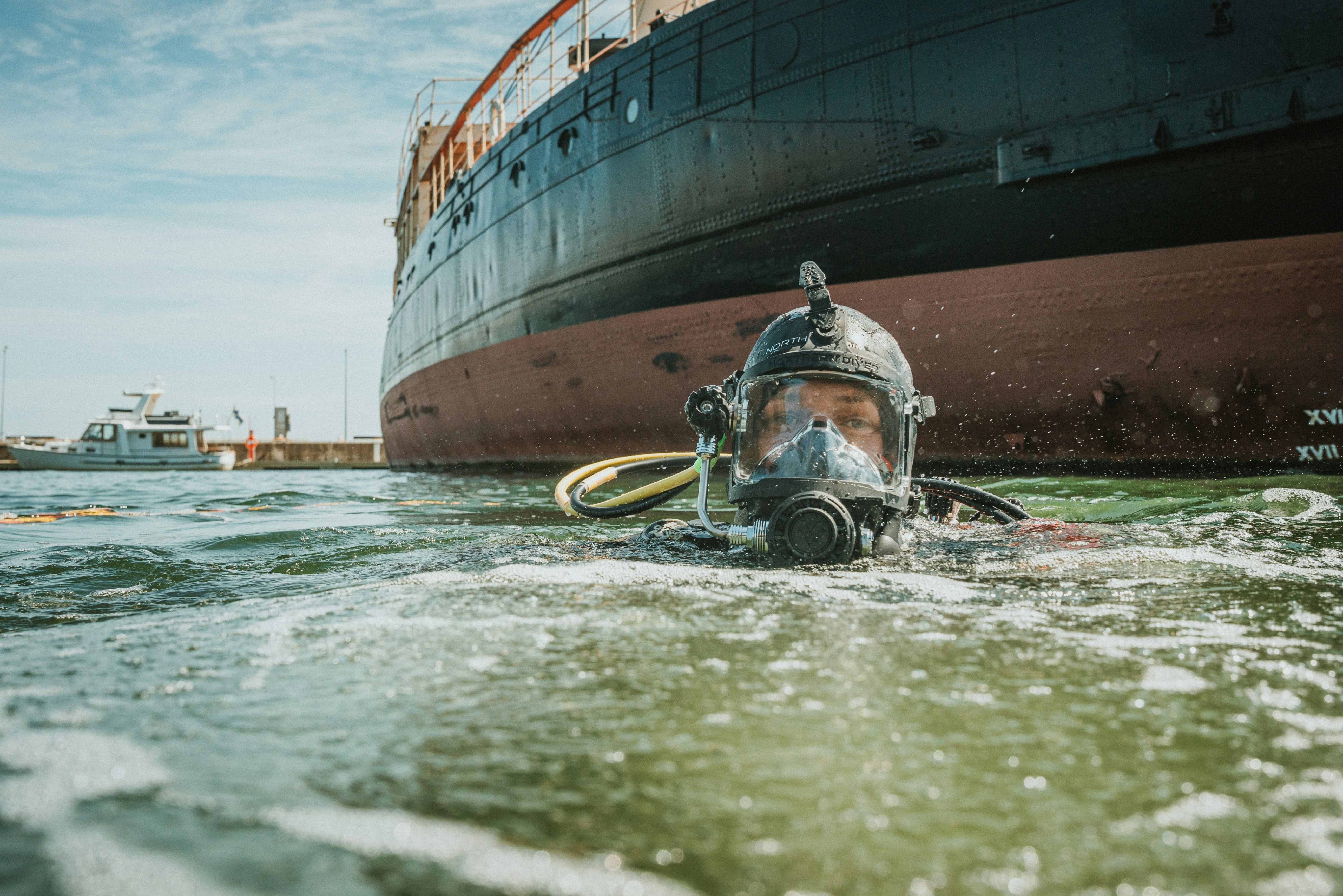
Hull Biofouling and Bunker Cost: Why Cleaning May Pay Back Within One Voyage

Hull Biofouling and Bunker Cost: Why Cleaning May Pay Back Within One Voyage
For some owners, the cleaning quote is visible. The bunker penalty is not.
A full hull cleaning and propeller polishing operation in Santos may cost around USD 15,000–17,000, depending on the vessel condition, fouling level, findings and working window.
At first sight, this may look like another operational expense. But for a fouled Panamax vessel preparing for a long ocean leg, the better commercial question is:
How much additional bunker will the vessel consume if cleaning is postponed?
For a 225–229 m Panamax or bulk carrier with visible biofouling, the extra bunker cost over one voyage leg — or over the next three months of trading — may be materially higher than the cleaning cost itself.
The figures below are illustrative and should not be treated as a vessel-specific performance guarantee.
The commercial logic
Hull biofouling increases surface roughness. More roughness means more drag. More drag means the vessel may need more engine power to maintain speed, or may lose speed at the same power.
The propeller also matters. A fouled or rough propeller can reduce thrust efficiency and contribute to higher fuel consumption, vibration or reduced speed response.
For this reason, hull cleaning and propeller polishing should not be seen only as a maintenance cost. In many cases, they are part of the vessel’s bunker-cost control strategy.
Panamax example: assumptions
Item | Illustrative assumption |
|---|---|
Vessel type | Panamax / Bulk Carrier |
Approximate LOA | 225–229 m |
Clean-hull fuel consumption | 30 MT/day |
Biofouling condition | NORMAM Level 2 reference |
Fouling penalty used in base case | 15% |
Bunker price assumption | USD 700/MT |
Europe–Brazil sailing leg | Approx. 19–20 days |
Cleaning cost in Santos | USD 15,000–17,000 |
Scope considered | Full hull cleaning + propeller polishing |
These assumptions should be replaced by the vessel’s actual noon reports, bunker price, speed profile, voyage plan and underwater inspection findings.
Cleaning cost vs bunker penalty
The table below uses a 15% fouling penalty and compares the estimated additional bunker cost against a USD 16,000 midpoint cleaning cost.
Scenario | Sailing days | Extra fuel consumed | Extra bunker cost | Estimated net position after USD 16,000 cleaning cost |
|---|---|---|---|---|
Europe to Brazil, one leg | 19.5 days | 87.8 MT | USD 61,425 | USD 45,425 |
Europe–Brazil–Europe round voyage | 39 days | 175.5 MT | USD 122,850 | USD 106,850 |
Next 3 months | 45 sailing days | 202.5 MT | USD 141,750 | USD 125,750 |
Next 3 months | 60 sailing days | 270.0 MT | USD 189,000 | USD 173,000 |
Even if a more conservative 10% penalty is applied, the potential additional bunker cost on a single Europe–Brazil leg may still exceed the cost of cleaning.
This is the core commercial point: the cost of postponing the service may be higher than the service itself.
Simple formula for owners
Owners can adapt the calculation using their own vessel data:
Additional bunker cost = Daily consumption × Fouling penalty × Sailing days × Bunker price
Example:
30 MT/day × 15% × 45 days × USD 700/MT = USD 141,750
In this example, a USD 15,000–17,000 hull cleaning and propeller polishing operation is small compared with the estimated bunker exposure over 45 sailing days.
The cost of doing nothing
Doing nothing is also a commercial decision.
Decision | Immediate effect | Commercial risk |
|---|---|---|
Clean now | Service cost is incurred | May reduce bunker exposure on the next voyage |
Postpone until next port | No immediate service cost | Vessel may continue burning extra fuel |
Wait until dry dock | No short-term intervention | Performance loss may continue for months |
Polish propeller only | Lower immediate scope | Hull drag may remain significant |
Inspect first, then decide | Evidence-based decision | Best option when fouling level is uncertain |
In many cases, the most practical approach is to inspect first, confirm the fouling level, assess coating sensitivity and propeller condition, then define the final cleaning scope.
Why propeller polishing should be included
Propeller polishing should not be treated as secondary.
The propeller converts engine power into thrust. If the propeller surface is fouled or rough, propulsion efficiency may be reduced. When the hull is already being cleaned, polishing the propeller is usually a logical complementary scope.
However, propeller polishing does not replace hull cleaning when the hull itself is significantly fouled. A clean propeller cannot fully compensate for a hull that continues creating excessive drag.
The best commercial assessment is usually to consider both together: hull condition + propeller condition + next voyage exposure.
Why Santos can be a strategic cleaning point
Santos can be a practical intervention point for vessels arriving in Brazil with visible biofouling.
For a Panamax vessel preparing for another ocean leg, cleaning in Santos may help the owner avoid carrying the same fouling penalty into the next voyage.
Planning should consider ETA, ETD, draft, weather, underwater visibility, currents, operational window, clearance, coating condition and required reporting.
Owners should compare the cost of cleaning in Santos with the cost of waiting until the next port or the next dry dock.
When a three-month cleaning cycle may make sense
A three-month cleaning cycle is not a universal rule.
It may be commercially justified when the vessel:
trades frequently in warm or tropical waters;
remains for extended periods at anchorage;
shows recurring biofouling findings;
reports speed loss or higher consumption;
has long ocean legs ahead;
has high bunker exposure;
requires evidence-based biofouling management records.
For a Panamax vessel burning around 30 MT/day, even a moderate fouling penalty over 45–60 sailing days can exceed the cleaning cost several times.
The cleaning cycle should be based on inspection, trading pattern, coating condition and operational feasibility — not on a fixed rule for every vessel.
Information required for a realistic assessment
To assess feasibility, cost and potential payback, owners should provide:
vessel name;
vessel type;
LOA, beam and draft;
ETA/ETD and port of call;
available operational window;
last dry dock date;
last hull cleaning or propeller polishing date;
recent underwater photos or videos, if available;
average daily fuel consumption;
planned next voyage;
bunker price basis;
required scope;
local agent details;
clearance status, if already available.
With this information, the underwater scope can be reviewed against the vessel’s actual commercial exposure.
Commercial conclusion
The question is not only how much hull cleaning costs.
The real question is how much the vessel may continue losing in bunker if cleaning is postponed.
For a Panamax vessel with visible biofouling, a USD 15,000–17,000 hull cleaning and propeller polishing operation in Santos may be lower than the additional bunker consumed during a single voyage leg.
Over the next three months, the difference can become much larger.
Owners calling Santos or another Brazilian port can request a feasibility review for NORMAM 401/DPC-aligned underwater cleaning support, based on vessel particulars, ETA/ETD, available window, inspection findings and intended scope.