Cargo Hold Cleaning Procedure for Bulk Carriers

Adopted Operating Standard, Quality Gates, Evidence Pack, and Compliance Controls (2025-2026)
1) Purpose, scope, and what “good” looks like
Cargo hold cleaning is a controlled technical operation performed to achieve verifiable readiness for the next cargo while reducing: contamination risk, delays, corrosion, disputes, and regulatory exposure.
This guide covers: bulk carrier hold preparation from post-discharge to survey-ready close-out, including cleanliness standards, step-by-step method, chemical logic, QA gates, and an evidence pack.
This guide does not replace: vessel SMS, cargo-specific instructions, terminal rules, charterparty clauses, or statutory/Class requirements.
2) Terminology and hold anatomy
Understanding terminology is essential because survey failures usually come from “small” missed zones.
2.1 Key structural terms (where residues hide)
Term | What it is | Why it matters in cleaning |
|---|---|---|
Tank Top | Horizontal “floor” of the hold | Primary cargo contact area; transfer risk is highest. |
Bulkhead | Main vertical walls | Residues cling and later fall onto cargo during loading/vibration. |
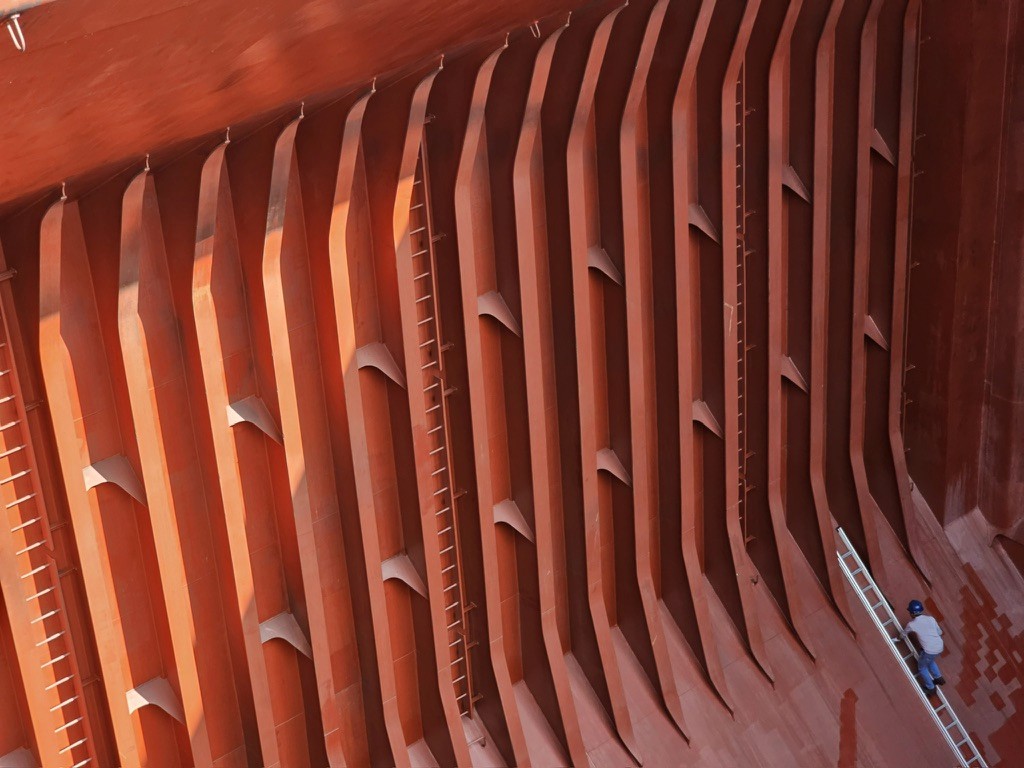
Frames / Stiffeners | Structural supports on bulkheads | “Shadow zones” behind frames trap dust and scale; common survey fail point. |
Hoppers | Angled side slopes | Collect sticky residues and wash streaks; hard to dry. |
Bilges / Wells | Lowest drainage pockets | Accumulate sludge; blockage causes recontamination and operational risk. |
Drain Channels | Paths to bilges/wells | If not swept first, washdown spreads contamination and clogs suctions. |
Hatch Coamings | Raised hatch edge structure | Dust and residues drop into holds during final inspection/loading. |
Underdeck / Overhead | Underside of hatch covers and deck plating | Fine dust remains overhead and later rains down—classic “surveyor rejection.” |
2.2 Operational terms (what owners/surveyors actually mean)
Term | Meaning in practice | What CARGOWARD® controls |
|---|---|---|
Top-down cleaning | Clean overhead to bilges last | Prevents recontamination of cleaned areas. |
Transfer risk | Anything that can contaminate next cargo | Dust, flakes, salts, oily films, odors. |
Evidence pack | Photo/video + checklist + logs | Makes readiness defensible and speeds acceptance. |
Quality gate | Pass/fail checkpoint per phase | Reduces rework, off-hire, and inspection surprises. |
3) Why each step matters (risk-to-step mapping)
This is the “why” behind the SOP — it’s what makes the guide useful and snippet-friendly.
Risk / Failure mode | What causes it | Step(s) that prevent it | Typical symptom |
|---|---|---|---|
Recontamination | Washing before dry clean; wrong sequence | Pre-sweep + Dry clean + Top-down wash | “Clean yesterday, dirty today” |
Survey rejection | Missed ledges/frames/overhead | Zone-based inspection + lighting + evidence mapping | Dust falls during inspection |
Cargo caking / quality claims | Salt residue; moisture pockets | Freshwater rinse triggers + drying gate | Wet corners, salt streaks |
Corrosion acceleration | Chlorides + poor drying | Freshwater + ventilation | Flash rust, coating breakdown |
Bilge blockage and sludge | Solids pushed into drains | Solids-first + bilge protection | Pump issues; dirty backflow |
Odor contamination | Organic residues; inadequate ventilation | Chemical logic + ventilation time | “Smell test” fails |
Disputes / claims | No proof of readiness | Evidence pack + signed QA | “No record = no defense” |
4) Cleanliness standards (adopted grades + acceptance criteria)
Standards vary by charterparty and receiver. CARGOWARD® converts “names” into measurable gates.
Standard | Typical use | Acceptance criteria (CARGOWARD® gates) | Evidence minimum |
|---|---|---|---|
Shovel Clean | Low sensitivity cargo-to-cargo | No large residues; drains accessible; bilges not blocked | Tank top + bilge photos |
Swept Clean | Dust control between similar bulks | No visible dust/loose residues on tank top/ledges; drains swept | Short video sweep + ledge close-ups |
Washed Clean (Sea Water) | General bulks | No adherent residues; no pooling; runoff controlled | “Before/after” per zone |
Grain Clean | Food/agri cargoes | Clean + dry + no loose scale; corners and overhead verified; odor-free if required | Full zone mapping + dryness proof |
Hospital/Stringent | Sensitive receivers/spec | Grain Clean regime plus near-zero tolerance for transfer risk (stains/films/flakes), plus agreed touch-ups | Extra close-ups + final sign-off |
5) Pre-planning: the decision inputs that define the method
Before tools start, CARGOWARD® defines the cleaning pathway.
5.1 Inputs
Last cargo: dusty vs oily vs hygroscopic vs organic/odorous
Next cargo: contamination intolerance; moisture sensitivity; biosecurity expectation
Water availability: seawater access, freshwater reserves, heating capacity
Time window: berth/anchorage, weather, ventilation hours
Hold condition: coating integrity, rust scale, drainage performance
Restrictions: terminal rules for wash water handling and waste landing
5.2 Output: Hold Cleaning Method Statement (HCMS)
Target standard per hold
Sequence and tooling
Chemical logic (if needed)
Waste plan
Evidence plan (photos/videos/checklist)
6) Step-by-step SOP (with purpose, method, and quality gates)
Phase 0 — Mobilization & controls
Purpose: prevent injuries, uncontrolled runoff, and rework.
Method: safe access, lighting, staging, PPE, and bilge protection.
Quality gate: access + containment + tools staged + permit controls OK.
Phase 1 — Pre-sweep of critical control points
Purpose: stop washdown from spreading contamination.
Method: sweep coamings, drain channels, overhead ledges, ladder landings, frame shelves.
Quality gate: channels visibly clear; overhead dust piles removed.
Phase 2 — Dry clean (solids removal)
Purpose: reduce contaminated wash volume and prevent sludge.
Method: shovel/scrape/sweep/vacuum tank top, hoppers, behind frames; isolate solids.
Quality gate: tank top free of loose residues; bilges/wells accessible and serviceable.
Phase 3 — Wet wash (top-down sequence)
Purpose: remove adherent residues without recontamination.
Method (mandatory order): overhead → upper structure → hoppers → tank top → bilges last.
Quality gate: no visible adherent residues; runoff isn’t redistributing dirt.
Phase 4 — Targeted chemical treatment (controlled tool, not default)
Purpose: remove films/stains/odors not removed by water.
Method: SDS/compatibility review, spot test, dwell time, full rinse, controlled runoff.
Quality gate: target residue removed + no chemical residue + full rinse complete.
Phase 5 — Freshwater rinse (as required)
Purpose: remove salts/chlorides that cause caking, corrosion, and rejection.
Method: final freshwater rinse focusing corners, hopper knuckles, tank top edges, bilge corners.
Quality gate: no salt-like residue visible; corners/ledges clean.
Phase 6 — Drying & ventilation
Purpose: stabilize readiness and prevent flash rust/odor issues.
Method: remove pooled water, forced ventilation, re-check shadow zones.
Quality gate: no free water; no wet corners; odor status as required.
Phase 7 — Touch-up actions (as agreed / per standard)
Purpose: eliminate loose scale/flaking coating that transfers to cargo.
Method: mechanical removal + localized rewash/dry.
Quality gate: no loose scale in transfer-risk zones.
Phase 8 — Final QA inspection + evidence pack
Purpose: close-out with objective proof and predictable acceptance.
Method: zone-by-zone walkdown with high-output lighting, rework list if needed.
Quality gate: checklist signed + evidence pack complete.
7) Chemicals: types, compositions, and selection logic (technical, practical)
Important: Specific brand names vary by availability. Below are functional categories and typical chemical compositions used in maritime cleaning. Selection must consider coating compatibility, SDS controls, and disposal rules.
7.1 Core chemical families (what they do)
Chemical family | Typical composition | Primary function | Main cautions |
|---|---|---|---|
Alkaline detergents / degreasers | Sodium or potassium hydroxide + non-ionic surfactants | Emulsify oils/films; remove oily stains | Can attack some coatings if too strong; requires full rinse |
Surfactant detergents (mild/neutral) | Non-ionic/anionic surfactants, builders | Lift dirt, reduce surface tension, general cleaning | Less effective on heavy oil; still requires rinse |
Solvent-based cleaners (controlled use) | Hydrocarbon solvents (low aromatic) + emulsifiers | Break down stubborn oily films | Higher handling controls; compatibility and vapor concerns |
Oxidizers (controlled, case-by-case) | Sodium hypochlorite solutions | Odor control, organic staining | Can affect coatings/metals; must be neutralized and rinsed |
Acid descalers / rust removers | Phosphoric / citric acids + inhibitors | Dissolve mineral scale, rust stains | Needs inhibitors; can etch coatings; neutralize and rinse |
Chelating agents | EDTA or similar chelators (often blended) | Bind metal ions; help rust stain removal | Must be well rinsed; compatibility checks |
Enzymatic cleaners | Protease/amylase/lipase blends + surfactants | Break down organic residues/odors | Needs dwell time; temperature helps |
Neutralizers | Sodium carbonate/bicarbonate (“soda ash”) | Neutralize acidic residues (e.g., sulfur behavior) | Must be collected/rinsed properly |
8) Chemical application matrix by last cargo → next cargo requirement
8.1 Decision matrix
Last cargo residue type | Next cargo sensitivity | Cleaning target | Primary method | Chemical logic (functional) | Finish |
|---|---|---|---|---|---|
Coal / Petcoke (dust + oily smears) | Grain / Food | Zero transfer risk, odor control | Heavy dry clean + top-down wash | Alkaline degreaser + surfactant blend (controlled) for oily films | Freshwater rinse + full dry |
Iron ore / bauxite (abrasive dust) | Grain / Food | No dust/scale transfer | Dry clean + wash, focus overhead | Mild detergent + chelator only if staining | Freshwater + dry, scale touch-up |
Fertilizers / salts (hygroscopic) | Grain / Sugar | Salt removal, dryness | Multi-cycle rinse | Neutral surfactants; freshwater emphasis (salts are the issue) | Extended ventilation |
Cement / clinker (mineral scale) | General bulk | Remove hardened deposits | Mechanical + wash | Acid descaler (phosphoric/citric) with inhibitors for deposits | Neutralize + rinse + dry |
Sulfur (reactive/acidic behavior) | General bulk | Prevent corrosion & residue | Dry clean emphasis | Neutralizer (carbonate) where required; controlled wash | Dry + possible barrier coat |
Fishmeal / organic residues | Grain / Food | Odor elimination | Dry clean + wash | Enzymatic cleaner + oxidizer only if justified | Freshwater + strong ventilation |
Vegetable oils / fats | Dry bulk | Remove slippery films | Hot wash if possible | Alkaline degreaser (saponification) + surfactant | Rinse + dry |
9) Detailed chemical “recipes” (composition-level guidance)
Below is guidance by composition (not brand). Actual dosing and dwell must follow SDS and method statement.
9.1 Coal/Petcoke → Grain Clean / Hospital
Problem: black dust + oily smear films; survey rejection from ledges and wipe transfer.
Recommended chemistry (functional):
Alkaline degreaser: hydroxide base + non-ionic surfactants (emulsification)
Optional: low-odor solvent-emulsifier blend for stubborn smears (controlled use)
Process:
aggressive dry clean (vacuum/brush ledges)
top-down wash
alkaline foam application on smear zones (dwell)
full rinse
freshwater rinse
dry/ventilate
Acceptance check: wipe-transfer risk on tank top edges and lower hopper knuckles.
9.2 Fertilizers/Salts → Grain/Sugar
Problem: salt carryover causes caking and acceptance issues; also drives corrosion.
Recommended chemistry:
Neutral surfactant detergent (to lift residues)
Freshwater rinse is the “active ingredient” here
Process:multiple rinse cycles focusing corners, bilge edges, drain channels; extended drying.
9.3 Cement/Clinker → General bulk
Problem: hardened mineral deposits and scale.
Recommended chemistry:
Acid descaler: phosphoric/citric blend + corrosion inhibitors
Neutralizer: carbonate rinse step after acid stage
Process:mechanical break-up first; controlled acid treatment on deposits; neutralize; full rinse; dry.
9.4 Fishmeal/Organic → Food cargoes
Problem: odors and organic films.
Recommended chemistry:
Enzymatic cleaner: protease/amylase + surfactant (dwell critical)
Oxidizer only if justified and controlled (coating compatibility + full rinse)
Process:enzymatic stage + warm water improves performance; ventilation is essential.
10) Barrier coatings (when used, what they are, and why)
Barrier coatings are applied when the next cargo is known to be corrosive or when a protective sacrificial layer is contractually required.
Barrier type | Typical composition | Purpose | Notes |
|---|---|---|---|
Lime wash | Calcium hydroxide slurry (sometimes with additives for removability) | Reduces direct contact between cargo and steel/coating | Requires uniform application and cure time; removal planned later |
Polymer film systems | Water-based polymer blends | Temporary protective film | Must be compatible with loading and later removal |
11) Evidence pack: what makes it “survey-ready”
11.1 Photo/video mapping (minimum)
Per hold: Zone A–E labeled set
Close-ups: ledges/frames behind ladders, hopper knuckles, bilge corners, drain channels
Short video sweep showing continuity
11.2 Logs and sign-offs
Cleaning timeline by phase
Waste tally and handling notes
QA checklist signed per hold
Final readiness statement: achieved standard + constraints + timestamp
12) Quick troubleshooting (if acceptance fails)
Finding | Likely cause | Corrective action |
|---|---|---|
Dust falls during inspection | overhead ledges missed | re-sweep/vacuum Zone A/B; rewash targeted |
Black streaks on tank top | petcoke smear not emulsified | alkaline degreaser stage + controlled rinse |
Salt streaks in corners | inadequate freshwater focus | repeat freshwater cycle + corner drying |
Wet bilge corners | poor drainage / ventilation | pump out + forced ventilation + recheck |
Rust flakes | scale not removed | mechanical removal + localized wash/dry |
13) FAQs
What is the safest sequence for hold cleaning?
Dry clean first, then wash top-down, apply chemicals only when justified, freshwater rinse when required, dry/ventilate, then QA inspection with evidence pack.
What makes a hold “Grain Clean”?
Clean and dry surfaces with no residues and no loose rust scale, including ledges/frames and bilges, with documented readiness for independent inspection.
When are chemicals necessary?
When films, stains, or odors cannot be reliably removed by water and mechanical cleaning, and when chemical use can be controlled (SDS, compatibility, dwell, full rinse).